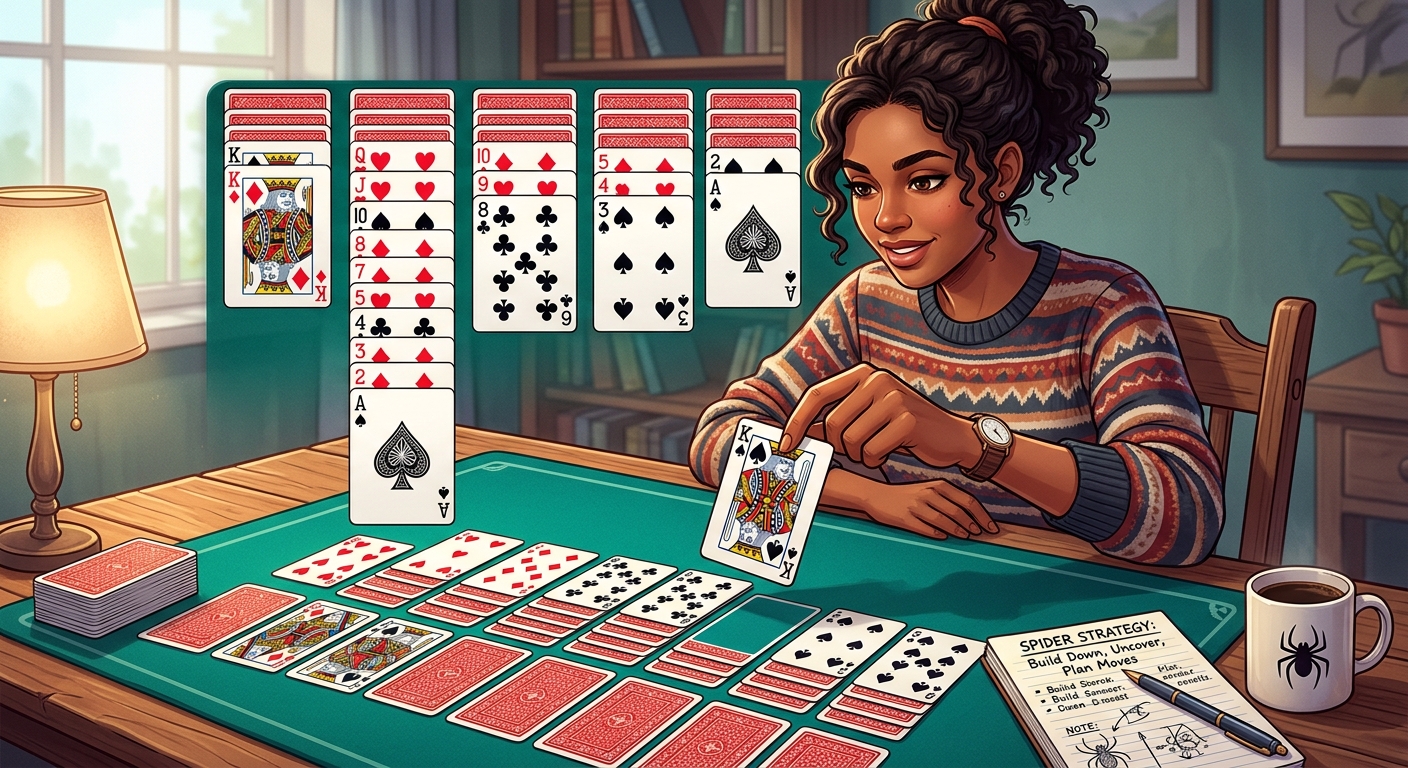
Most players assume Spider Solitaire is mostly luck. They lose a game, shrug, and click "new deal." But players who win consistently know something different: the cards you get matter far less than the choices you make with them. The gap between a 10% win rate and a 40% win rate usually comes down to a handful of decisions made in the first half of the game, not the randomness of the deal. This article walks through the core habits that shift Spider Solitaire from a frustrating guessing game into something you can actually control.
Your Winning Edge: Key Takeaways
- Empty columns are your most powerful resource. Create and protect them deliberately.
- Build one or two suits toward completion before spreading progress across all four.
- Drawing new cards too early buries the cards you need and collapses winnable positions.
- Every move has a cost. Recognizing tradeoffs is what separates consistent winners from reactive players.
- Mid-game bottlenecks are easier to manage when you trace two to three moves ahead before committing to the first one.
Why Spider Solitaire Is a Skill Game in Disguise
Spider Solitaire became a household game for millions after Microsoft bundled it with Windows, but its documented origins tell an interesting story: it was never designed to be a pure luck game. Two full decks, ten columns, and eight suits to complete give skilled decision-making far more room to operate than a simpler card game like Klondike. With 104 cards in play and dozens of possible moves at any given moment, the player who thinks ahead consistently outperforms the player who just reacts.
The numbers reflect this. An experienced player who manages columns well and draws cards at the right moments can win roughly 30 to 40 percent of four-suit Spider games. A player who moves reactively without a plan often wins fewer than one in ten. The deal does not change between those two players. The approach does.
That difference lives in three areas: how you manage your columns, how you decide which suits to build, and when you choose to draw from the stock. Get those three things right and the influence of luck shrinks dramatically.
The Real Power of an Empty Column
Clearing a column entirely is one of the most decisive moves you can make in Spider Solitaire. An empty column is not just open space on the tableau. It is a flexible holding area that gives you options you would not otherwise have. You can use it to break apart a long sequence, shift a card that is blocking progress elsewhere, or temporarily park a high card while you reorganize the cards below it.
Many players rush to fill empty columns the moment they appear. Dropping a long run into an open column feels productive. It looks tidy. But that move often burns a resource that would have been far more valuable kept open just a bit longer.
Here is a concrete example. Suppose you have a King of Clubs and an empty column. Parking that King there makes sense only if it frees up two or three useful moves elsewhere on the tableau. If parking it fills your only open column and creates a dead end, you have traded your most flexible tool for a minor gain. The empty column was worth more than the convenience of housing one King.
The habit to build: before filling an empty column, ask what it is buying you. If the answer is not much, keep it open. Empty columns are like wild cards in your hand. The longer you hold them, the more situations they can solve.
Suit-Building Priority: Focus Beats Balance
Spreading effort evenly across four suits feels productive. The tableau looks active. Sequences are forming everywhere. But in practice, that approach means none of the suits progress far enough to complete before the stock runs out. Half-finished progress on four suits earns you nothing.
Completing a single suit removes eight cards from the tableau entirely. That clears real space and gives you new room to work. Choose one or two target suits early and channel your decisions toward finishing them before worrying about the rest.
A good target suit has several of its cards already visible and positioned in places you can reach without demolishing everything else. You do not need perfect conditions. You need enough cards accessible to build consistent momentum. If you find yourself making moves because they look tidy rather than because they push a target suit forward, you have drifted into reactive play.
Short runs in the wrong suit are worth less than focused work on a suit you can finish. That one idea alone will change how you read the tableau from one deal to the next.
When to Draw New Cards and When to Hold Off
Drawing from the stock is irreversible. Once you flip a new row of cards, they are in play and there is no undoing it. That makes drawing one of the highest-stakes decisions in the game, yet most players treat it as an afterthought.
The guiding principle is straightforward: draw only when you have exhausted every useful move available. "Useful" does not mean every legal move. It means moves that push a target suit closer to completion, open a column, or expose a face-down card you genuinely need. Moving cards around just because you can is not progress. It shuffles the problem without solving it.
Drawing out of impatience is one of the fastest ways to collapse a position that could have been won. New cards add more to manage. They can bury sequences you were building and block pathways you were counting on. Think of drawing as a deliberate reset after you have genuinely run out of productive moves, not a shortcut when things start to feel slow.
Before every draw, run one final check: is any column close to empty? If you can clear a column with two or three more moves, do that first. An empty column entering a new round of cards is worth far more than a packed column receiving five more it has nowhere to put.
Planning Ahead When the Mid-Game Gets Messy
The mid-game is where most Spider Solitaire losses are actually decided. The opening is relatively manageable: expose cards, build early sequences, protect column space. The endgame tends to sort itself out if you set it up correctly. But the middle stretch, usually between the third and fifth stock draws, requires the most discipline and the clearest thinking.
At this point, the tableau is dense. Partial sequences in mixed suits pile up. Cards you need sit three or four positions deep. The temptation is to respond to whatever is directly in front of you rather than trace what needs to happen several steps out.
Reactive play in the mid-game looks like this: you spot a valid move, make it, then repeat. It feels productive in the moment. But without a direction, those moves often close off the very pathways you need to finish a suit. You look busy while actually backing yourself into a corner.
Approaching Spider Solitaire strategy with a planning mindset pays off most during this phase. Before committing to a major move, trace the sequence it starts. If moving a red Nine will free a black Eight that opens a column that exposes the Six of Spades you need, that chain is worth taking. If moving that Nine just produces a run with nowhere meaningful to go, look for a better entry point first.
The mid-game skill is not about knowing the single perfect move. It is about seeing two or three moves into a chain before you begin it. That habit, practiced consistently, is what separates players who break through mid-game bottlenecks from those who get buried in them.
How Priorities Shift as the Game Progresses
Your goals in Spider Solitaire are not static. What matters in the opening becomes less critical by the late game, and decisions that seem low-stakes early become very costly near the end. Understanding that shift helps you make better choices in the moment.
| Game Phase | Primary Goal | What to Protect |
|---|---|---|
| Opening (draws 1, 2) | Expose face-down cards, build early suit sequences | Column flexibility and open spaces |
| Mid-game (draws 3, 5) | Drive one or two suits toward completion | Target suit sequences, any remaining empty columns |
| Late game (final draws) | Clear remaining suits and finish the tableau | Every single move , errors here are very hard to undo |
Making Every Deal Count, Whatever the Cards Look Like
Spider Solitaire is a game of tradeoffs. Almost every move involves giving something up to gain something else. Filling a column costs you flexibility. Drawing too early costs you predictability. Chasing all four suits at once costs you the concentration needed to finish any one of them.
Recognizing that every move carries a cost is the core mindset shift that changes how you play. Instead of asking "what can I move?" you start asking "what does this move give up, and is the gain worth it?" That question sounds small, but it rewires how you approach every deal.
The good news is that most of these tradeoffs follow recognizable patterns. The more games you play with this framing, the faster those patterns become instinct. A position that felt hopeless six months ago might feel manageable today, not because the cards are kinder, but because your reading of the board has sharpened.
Prioritize empty columns. Build suits with focus rather than coverage. Draw deliberately and only after exhausting useful moves. Plan two moves ahead in the mid-game before committing to the first. Those four habits will raise your win rate meaningfully, not by hoping for a better deal, but by getting more out of every deal you are given.